

Wealth Migrate is a leading Fintech real estate investment platform that make investing in high yield, institutional quality, first world real estate accessible, safe and affordable for anyone online.
My Role
research, wireframes, visual design, prototypes
Tools
Figma, Miro, Balsamiq
Market Research
- Real Estate investors are recognising the power of real estate investing using technology, but do not have an easy and safe way to invest in real estate markets globally – residential or commercial – and diversify.
- There are high barriers to overcome to invest & manage residential, commercial & offshore real estate.
- Offering global deals is extremely difficult (legal & banking, trust, compliance, deal quality)as this is also a design consideration and ultemately determine the design outcome.
- 49% of the world’s wealth is held in global real estate, which has been inaccessible to the person on the street.
- Only 12.9% of the world’s population have access to real estate..
The Problem
We detected some friction areas in our customers’ first experience with the product, which resulted in a suboptimal conversion rate.
From the total number of users who signed up on the platform, many never completed their profile verification after registration, funded their wallet after profile setup, or made their first investment even though funds were available.
Wealth Migrate also required a native mobile version of their app that allow investors easily and safely invest in global real estate.
The Solution
- Improve the existing web app by creating multi platform, natively compiled app.
- Streamline the on-boarding process.
- Ultimately, improve the sign up, KYC (Know Your Customer) profile verification and investment process.
The idea is to change the user flow to run through structured steps and guide the user from the moment they sign up until their profile is approved and investment has been completed
Discovery: validating our initial hypothesis and defining the problem
The first step in solving the problems we had to define it. In order to do so, we decided to interview people from the Wealth Migrate user base who had signed up but never made their first investment.
We asked them about the reasons why they signup in the first place, the expectations they had, their first impressions, and overall experience with the product.
Additionally, we asked them to walk us through the app and show us what they understood, what wasn’t clear, what they liked, and what frustrated them.

Furthermore, we also conducted user tests with the existing platform, testing people that corresponded to Wealth Migrate’s target audience but who had never used the product before to get a better sense of the problems that may arise when using the platform for the first time.
Throughout this process, we made valuable discoveries, such as the following:
- Some users pointed out the profile verification(KYC) process was too long.
- Users also did not have their verification documents at hand, such as their Identity document or ID book, proof of residence and bank account documents.
- Users did not know after their profile was verified that they had to fund their wallet to make an investment.
- Users was also not aware of the risk involve in investing
This helped us complete our user journey (from the kickoff meeting) with real data and observations, and allowed us to easily identify the main pain points in that journey and create a clear roadmap for the project.
Remote Kick Off
The project manager, stakeholders and I kicked off the project by running a few UX workshops in order to gain a deeper understanding of the problem, the users and the broader product strategy.
These workshops, all held at remotely, included a goal-setting session to make sure we were on the same page in terms of high-level direction and objectives; a persona workshop to understand the target audience, and a user journey workshop to map out our hypothesis concerning the main pain points users were facing.
Finally, we defined key job stories to clarify our hypothesis regarding the goals users might want to achieve with each of the features we were planning to work on.

Personas
To start off, the team and I created personas of potential Wealth Migrate users based on our understanding of investors who were on current web platform.
These personas was created with assumptions and not fully research-based but it was something that I came back to throughout my project to guide my design decisions and priorities.


Competitor Analysis
While the team was busy with the previously mentioned discovery research, I studied Wealth Migrate’s competitors to see what each of them was doing differently, gain a better understanding of the market and gather inspiration.

User Journeys
To help us visualize and identify the different elements of the process, and the interrelationships among the various steps, we used the diagram flow (created for MVP) as a graphical representation.

Ideating, prototyping and testing
Once the problems were defined, the time had come to ideate, prototype and test. Together, the product manager and I ideated on different approaches to solving the problems at hand before agreeing on a direction.

Once the flow diagram was established, I started sketching with pen and paper the low-fidelity wireframes of the main user flow.
The first low-fidelity prototype was then created and was then tested with a number of internal stakeholders.
The prototype was then iterated on a weekly basis over the remaining duration of the project. As is always the case, the initial tests revealed multiple problems from the originals ones that hadn’t been solved, as well as new ones that arose from the new design, and paved the way for weekly conversations with the stakeholders.
As the weeks passed, these problems were tackled one by one until, in the final weeks, test participants were able to perfectly understand the product’s value and use it without any instructions.

Styleguide and Design System
Once the problems where solved, a styleguide was created with Figma that reflect the new corporate style and ensures brand consistency with design, development and writing.
To create a consistent experience across the platform I created a Design System with a collection of reusable functional components.
We decided to build, test and document our components on Storybook. This enabled the developers to manage the components in isolation from the platform code.


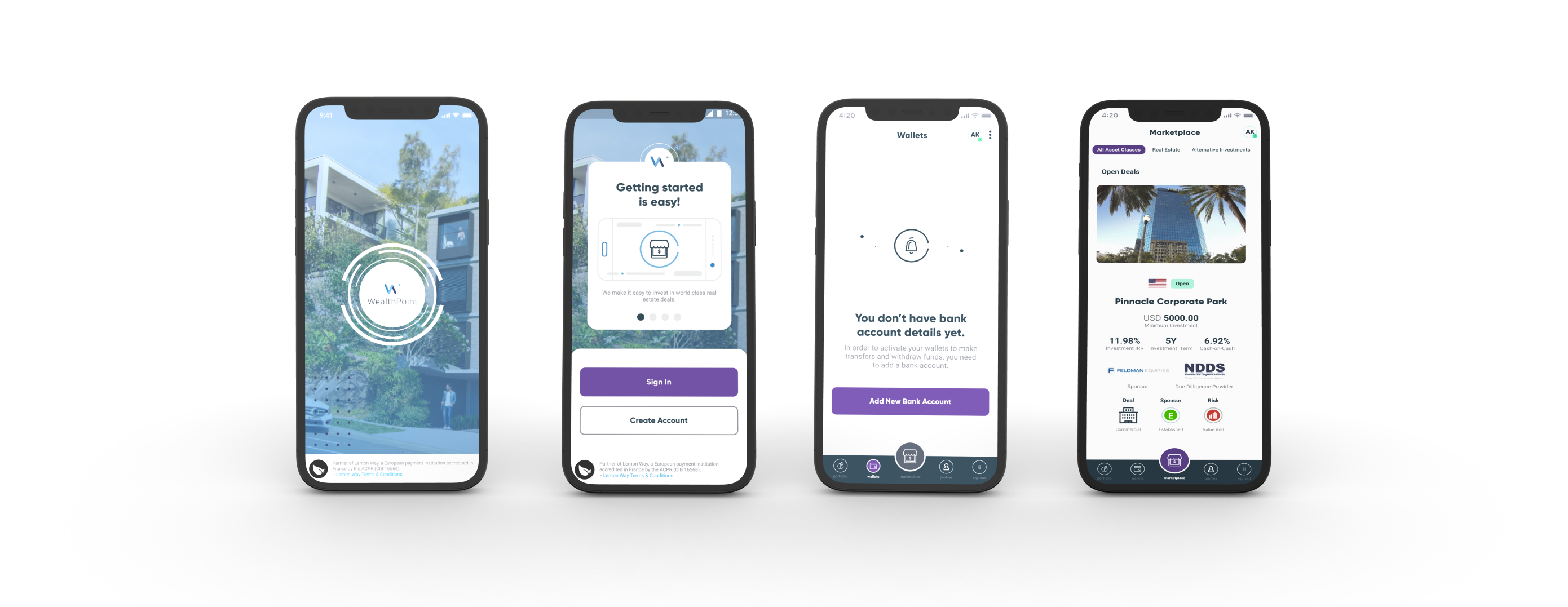
High-Fi Designs
All major design screens with features, including different states and edge cases were designed and handed over to the development team to start development. These screens were shared on Confluence and linked directly to the figma shared files.
An interactive visual prototype was created and more usability testing was done with stakeholders and existing investors.
Project Summary
During the project, i managed to evaluate the market research, create a set of lo-fi wireframes, build them into hi-fi UI designs, connect them into a protoype, and perform a usability study.
This was demanding and time consuming but very insightful journey. I learned a lot throughout the whole process but I’m not resting on my laurels. There is a lot of room for improvement and many things to learn.